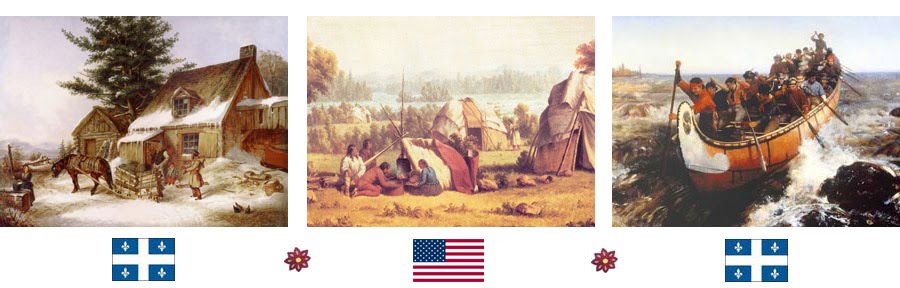
When—thanks to my cousin’s information—I found my great-grandfather Vincent Dufauld with his parents in the 1880 census at Bayfield, Wisconsin, and in the 1860 census at La Pointe on Madeline Island (about 2 miles offshore of Bayfield), I had no idea of the depths that I was wading into now. What I quickly learned was that in a very real sense, Madeline Island is “home” to the Anishinaabe people and played a vital role in the fur trade.
Ancient Anishinaabe oral tradition tells us that our people lived originally on the east coast, near the mouth of the St. Laurence River, but before the arrival of the first Europeans, we were led by our spiritual leaders and by visions to seek our predestined home to the west. Over the course of centuries, we migrated westward until we reached the place where food grows on the water. The food was wild rice, and we first encountered it here, in Chaquamegon Bay and its tributaries, as well as in the nearby ponds and lakes.
Early French explorers established a fort in 1693 at what became Madeline Island, but the fort fell out of use and disappeared. However, for fur traders heading to the far end of Lake Superior and points farther west, Madeline Island’s location still made it an ideal stopping place to get fresh supplies, rest, and interact with one another. By the time of the American Revolution, a Quebec trader named Jean-Baptiste Cadot had set up a trading post on the island with the help of his Anishinaabe wife Equawaice (baptized Marie Athanasie) and her powerful clan. Jean-Baptiste and Equawaice were my 5G Grandparents.
Their son Michel married Equaysayway (Traveling Woman), a daughter of the head of the White Crane clan of Anishinaabe on the Island. Michel and Equaysayway, my 4G Grandparents, after years traveling in the active fur trade, settled at La Pointe during the early 1800s. La Pointe, which was still a major rendezvous point for the fur trade, soon became a company town for the American Fur Company, which relied on Michel’s good will and influence in order to stay in business there.
Like an Anishinaabe high chief (although he never had the formal title of one), Michel had enormous influence with his Anishinaabe relatives and neighbors. Like every good Anishinaabe chief, he was noted for his generosity: he gave away much of what he acquired to others who were in need, and died virtually broke. Among the Anishinaabe he was known far and wide as Kitcheemichene or Gitcheemichene; the “michene” part was the Anishinaabe version of “Michel” (the Anishinaabe language does not have the sound of “L”), while those of you who have read Longfellow’s “The Song of Hiawatha” may recognize “kitchee” or “gitchee” from the poet's name for Lake Superior: “Gitchi-gummi”, “Big-sea-water”.
Modern folks usually translate “Kitcheemichene” as “Great Michael”, as in “Michel the Great”, suggesting the title given to some European monarchs and Popes. I think the appellation has a more literal meaning: Michel had a first cousin who was also named Michael and who from an early age was also active in the fur trade. The cousin was much smaller in size compared to Michel "Le Grand" of La Pointe and was therefore known as "Le Petit". To the Anishinaabe—and to other fur traders—Michel was simply “Big Michel” as opposed to “Little Michel”. Being his descendant, I tend to think of him less formally, with affection, as “Big Mike”, and so far he hasn’t objected.
In 1830, when Michel was 67 and Equaysayway was about 60, they and all their children traveled all the way to Mackinac Island for the church wedding they had never been able to have. Now, this was a very long journey to make, although I expect the family hitched a ride with an American Fur Company ship as far as Sault Ste Marie instead of paddling canoes all the way. Today you can drive the distance (about 375 miles in a fairly straight line) to St. Ignace and take the ferry to Mackinac, all in about 8 hours. But in those days, you had to go by boat the whole way, and if you followed the coast, the distance at least 500 miles and the travel time very much longer than it is now.
Why did the old couple make such a long and doubtless strenuous trip? To prove their devotion was genuine and not just a relationship to foster fur trade profits? While I like to think so—and it certainly sounds extremely romantic—I’m sure there was a legal consideration involved as well: under the laws of that time, if a couple did not have a legal marriage ceremony (Indian marriages, with or without ceremony, didn’t count) their children could not inherit their property and everything would be distributed to collateral relatives with impeccable marriage credentials. The marriage record specifically states that the marriage act legitimized all of their children, all of whom were present. Before the ceremony, Equaysayway was necessarily baptized a Catholic, taking the name of Madeleine, and the island where they lived was named in her honor.
After the wedding the entire party returned home to La Pointe, and Michel, along with other Catholic inhabitants of the area, began lobbying for a Catholic mission to be established there. (A Protestant mission was established In 1831, but most voyageurs—the men who did the hard work—were French-speaking Catholics.) In 1835, the Catholics succeeded: a Slovenian missionary named Frederic Baraga, who had already established a mission at St Ignace, agreed to establish one at La Pointe. This was extremely good news for the people living or working in that area; it was also good news for their genealogy-minded descendants, since the mission records survived to provide the documentation we would need to connect those ancestors to their families in Quebec.
The lead carpenter on the island was Joseph Dufaut, who had built the Protestant mission as well as the American Fur Company’s expanding headquarters on the island. Joseph, a good Catholic, readily agreed to build the Catholic church and a house for the priest as well. (In 1842-43 he built a larger church to replace the first one, needed because the congregation had outgrown the first mission.)
The St. Joseph Mission opened on 2 August 1835 and was immediately swamped with Catholics of all ages seeking baptisms and proper marriage ceremonies. The second marriage performed by Baraga that day was between my 3G grandparents: the carpenter Joseph Dufaut and Julie Cadotte, daughter of Michel and Equaysayway. And as I later learned, the 6th baptism on that day was for Joseph and Julie’s son Michel, who was about 5 years old at the time and named, obviously, for his grandfather. The same day, Joseph himself was baptized, age 45. (He had surely been baptized at birth, but not by a priest, and therefore there was no official baptism record for him. A conditional baptism was therefore needed before he could be married to Julie in a Catholic church. A distinguished historian and scholar cousin, Theresa Schenck, states that Joseph and Julie had a legal marriage at Sault Ste Marie but for some reason did not get Joseph baptized and have a Catholic marriage ceremony there.)
Michel Dufaut/DeFoe/Dufauld, the only child of Joseph and Julie, became a carpenter like his father, and in due course married Josette Roy, daughter of a prominent fur trader named Vincent Roy (fils). Michel and Josette, my Great-Great-Grandparents, produced at least 8 children, of whom the eldest son was my Great-Grandfather Vincent Dufauld.
None of this information was hard to find; the Cadottes (Cadots on the Quebec side of the border) are not only rather famous but exceptionally well documented. Michel Dufauld’s first cousin, William Whipple Warren (1825-1853), author of History of the Ojibway People, got most of his information directly from his grandmother Equaysayway and from tribal elders. A new edition of this book was published in 2009 by the Minnesota HIstorical Society Press, edited by cousin Theresa Schenck. I recommend it very highly.
Many vital records for Lake Superior voyageurs (including Dufauts and Cadottes) are in the parish registers for St. Ann on Mackinac Island. I purchased a digital copy of the original registers on CD-ROM from the church's gift shop. (The CD-ROM is still available from that gift shop, although the price has naturally gone up since I bought my copy.) The original St. Joseph Mission registers are no longer accessible to the public, but the marriage and burial registers were transcribed and published by Linda Bristol some years ago and I was able to obtain photocopies of those transcriptions.
Although I still wanted to examine the original records if possible, the entire web of connections was not seriously in question. I had the bare bones of these generations of my Dufauld ancestry fairly firmly established within a few months of beginning my research, and I was feeling rather proud of myself.
I had no idea of the perils that lay ahead.


 Posts
Posts